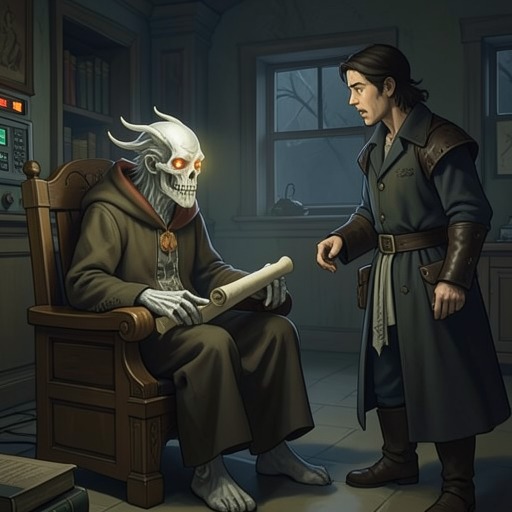
Vainqueur–Furibon
Vainqueur the DragonVainqueur–Furibon is defined by domination without submission. Furibon is physically confined within Vainqueur's scythe, while Vainqueur treats the weapon and its imprisoned voice as part of his hoard, military power, and royal authority. Yet Furibon's continued ability to speak preserves a narrow but unmistakable independence: he cannot escape the scythe, but he can still judge, mock, and embarrass its owner. Their relationship therefore makes control visible as an unstable arrangement rather than a complete victory.
The Scythe as Prison and Instrument
Furibon's presence inside the scythe gives the relationship its material structure. The scythe is not merely a weapon that Vainqueur carries; it is also Furibon's enclosure and speaking position. That doubleness makes the object unusually conspicuous. In the surrounding ceremony of treasure, weapons, and magical items, the scythe functions as a token of Vainqueur's authority, but its trapped occupant turns the same object into evidence of an unresolved enemy. Vainqueur possesses the instrument, yet Furibon's voice continues to emerge from it.
During the preparations for Vainqueur's Bragging Day, the scythe is explicitly returned to the hoard as a token of fealty. The surviving minions place their magical items atop the treasure pile, and the flying Grand Vizier throws the scythe onto it along with the other objects. The gesture presents Furibon's prison as part of a collective act of submission to Vainqueur. The scythe is absorbed into the dragon's accumulated wealth, but Furibon is not rendered silent or psychologically compliant by that ceremonial absorption.
Furibon's Resistance Through Speech
Furibon's resistance is expressed through disgust rather than physical action. After Vainqueur and Victor Dalton exchange an unusually affectionate declaration of loyalty, Furibon finally speaks from inside the scythe and says, "I want to puke," adding that watching them gave him diabetes. The remark is comic, but it also clarifies the limits of Vainqueur's power. The dragon can imprison Furibon's body and command the weapon, yet he cannot force Furibon to endorse the emotional bond being celebrated around him.
The timing of the interruption matters. Vainqueur has just promoted Victor Dalton to his first and only friend, framing friendship as an honor that Victor must prove himself worthy of receiving. Furibon's disgust cuts across that ritual of recognition. From inside the object that symbolizes Vainqueur's dominion, the bound enemy refuses the language of honor and exposes the sentiment as excessive, embarrassing, or physically nauseating. His speech converts confinement into a vantage point from which the master's performance can be ridiculed.
Fealty, Possession, and the Limits of Control
The scythe's return to the hoard also places Furibon within Vainqueur's broader logic of possession. Magical items are treated as things that minions may borrow but must ultimately return when the cycle of life demands it. The object is therefore governed by a system in which loyalty is demonstrated through surrendering personal equipment to the dragon's treasure. Furibon's imprisonment intensifies that logic: unlike an ordinary item, the scythe contains a hostile consciousness, so the supposedly obedient object remains capable of refusing the social meaning assigned to it.
This contradiction distinguishes Furibon from the other minions. Their returned items enact voluntary or enforced fealty, while Furibon's scythe carries the residue of an enemy that has not been reconciled with Vainqueur. The ceremony can display the weapon as conquered property, but it cannot erase the antagonism lodged within it. Vainqueur's authority is thus materially impressive and rhetorically vulnerable at the same time.
A Relationship Sustained by Antagonism
The available scenes do not show reconciliation between Vainqueur and Furibon. Instead, they preserve a recurring pattern: Vainqueur consolidates authority through titles, hoard rituals, and declarations of loyalty, while Furibon answers from confinement with contempt. Their relationship is consequently less a resolved victory than a durable arrangement of domination and irritation. Vainqueur controls Furibon's location and use; Furibon retains the power to interrupt the atmosphere of triumph.
That arrangement gives the scythe a relational meaning beyond its practical function. It embodies Vainqueur's ability to turn an enemy into property, but also the failure of property to become entirely inert. Furibon's voice survives inside the master's emblem, making every display of possession carry an unwanted reminder of conflict. The relationship's comic energy comes from that imbalance: Vainqueur has the overwhelming material advantage, yet Furibon can still make the powerful dragon look ridiculous.